CSIR tool helps African ports measure sustainability and prioritise investment in green technology
Coastal scientists at the CSIR assisted the Port of Ngqura in South Africa and Port Victoria in the Seychelles in assessing their ports’ sustainability performance using a new tool developed by the research team.
Susan Taljaard, a coastal water quality expert at the CSIR’s Coastal Systems Earth Observation research group, explains that while international sustainability assessment tools exist, they are not locally relatable for application at the port level and are often too scientifically complex for port operators to use.
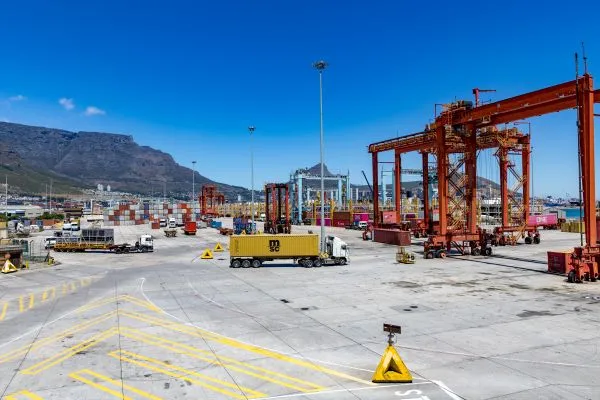
Busy ports: coastal scientists at the CSIR assisted the Port of Ngqura in South Africa and Port Victoria in the Seychelles in assessing their ports’ sustainability performance using a new tool developed by the research team. While international sustainability assessment tools exist, they are not locally relatable for application at the port level and are often too scientifically complex for port operators to use. This prompted the CSIR to develop a globally comparable yet locally relatable Port Sustainability Performance Index.

To address this challenge the team developed a Port Sustainability Performance Index, which has the flexibility of being globally comparable, but locally relatable. The tool was piloted at the two ports as part of a UN Environment Programme (UNEP)-funded project focused on sustainable port development to stimulate a regional blue economy.
The index measures economic, social, environmental and governance sustainability in line with the United Nation’s 17 Sustainable Development Goals. Following its successful application at the Port of Ngqura and Port Victoria, plans are in place to roll out the tool to all commercial ports in South Africa, as well as ports across the Western Indian Ocean region.
Steven Weerts, a coastal ecologist in the same research group, highlights the growing need for good environmental stewardship in ports, with increasing requirements for formal sustainability reporting.
He says that the overall score provided by the new tool is valuable for comparing performance across ports or within the same port over time.
The CSIR has also demonstrated the index to the Port of Rotterdam and, more recently, to a smaller municipal port in the Netherlands. “We have also recently refined the index for broader application in African ports, in partnership with Port of Mombasa in Kenya and Port Louis in Mauritius,” says Weerts.
Taljaard says that although sustainability performance assessments are not yet a legal requirement, ports are increasingly under pressure to demonstrate environmentally and socially responsible practice to secure their future ‘license to operate’.
“When we piloted the index at the Port of Ngqura, which is the head office of Transnet National Port Authority, it was inspiring to observe the buy-in from different departments and across management levels” she says. “We were pleasantly surprised by how quickly the ports connected to the index because we made it accessible in a language they could understand.”

She explains that other existing international tools are often difficult for port staff to interpret and apply, so the team worked hard to simplify and localise highly scientific concepts. “We didn’t want to make it a more complex process and that’s one of the main reasons we insisted the index be locally relatable,” says Taljaard.
Ports can use a simple spreadsheet to populate the index with their own data to obtain port-specific performance scores. These scores could reflect, for example, how well ports manage waste, whether they account for cultural and heritage protection, and how satisfied their employees are.
Weerts says an incentive system based on sustainability scores is being considered. “There are examples of where such assessment tools are used to award and certify a port’s sustainability status.”
A good sustainability status could reward ports in several ways, including financial, operational, and reputational benefits. “There are already tangible benefits in shipping companies prioritising ports with green initiatives, such as reduced emissions and efficient waste management,” says Weerts.
Weerts says that the Port Sustainability Performance Index, together with the Port Sustainability Toolkit for the Western Indian Ocean developed by the research team, will ultimately serve the port sector that supports national and regional economies. This is being done through ongoing partnership with Port Management Association for Eastern & Southern Africa, with CSIR supporting sustainability-related initiatives and engaging with its network of port authorities and maritime stakeholders across eastern and southern Africa. This relationship provides an important mechanism for connecting scientific expertise with the practical needs of the port sector in Africa.
“Ultimately, sustainability is not simply an environmental consideration, but an important driver of long-term investment value, operational resilience and port competitiveness,” he says.
This research was a collaboration with Delft University of Technology in the Netherlands, South Affrica’s Transnet National Port Authority and UNEP’s Nairobi Convention Secretariat.